
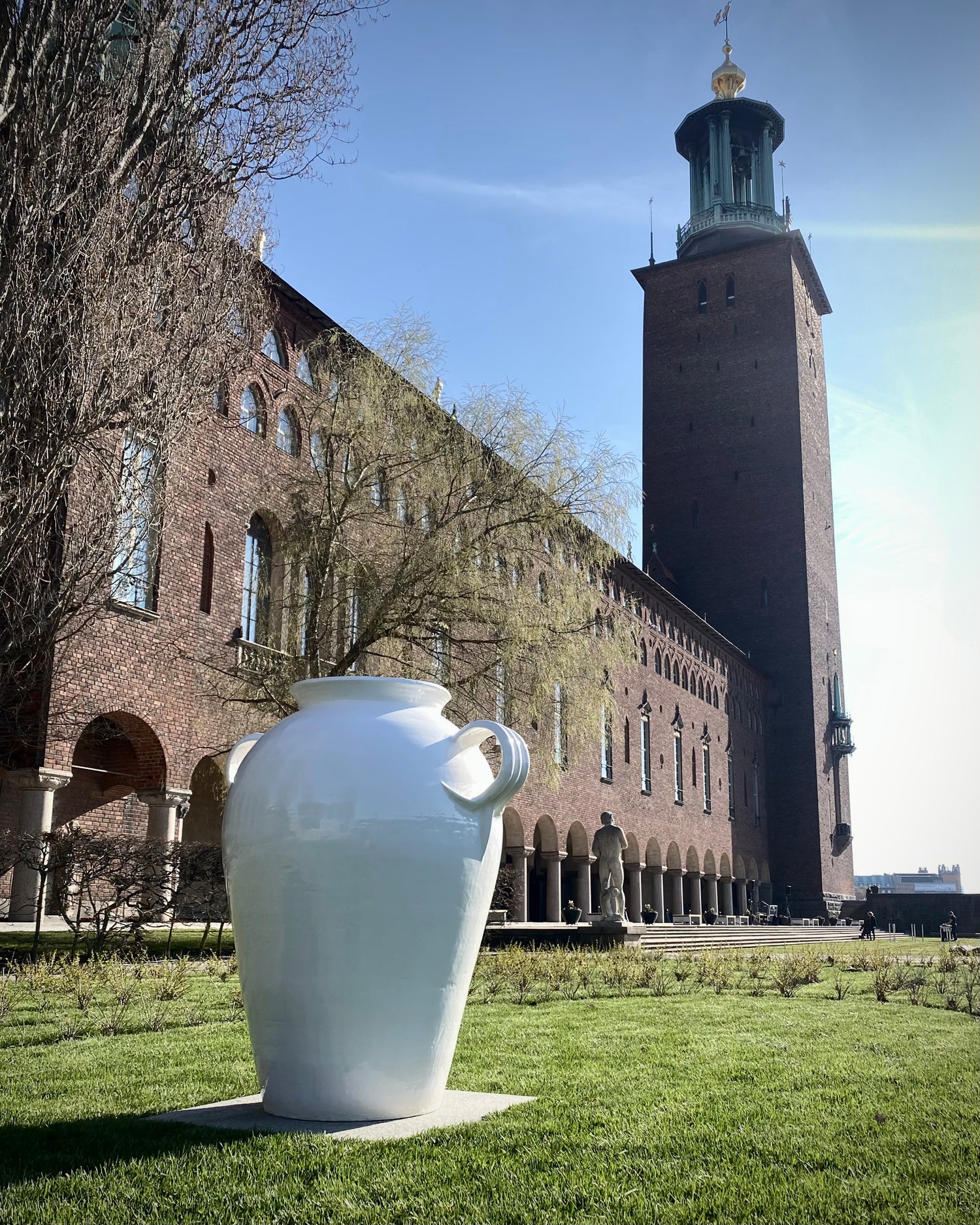
STOCKHOLM CITY HALL PARK
For the 100th-anniversary celebration of Stockholm City Hall, I was commissioned to recreate the urn that stood in the Embroidery Parterre in the park outside the City Hall in the early 20th century.
In the images and texts below, you can read about the manufacturing process.

SIZE AND PROPORTIONS
There is almost no documentation of the urn's original appearance. Based on the only available image and the city antiquarian's assessment of the urn's probable total height, I sketched the urn's proportions.

MATERIAL
The original urn was almost certainly made of faience (earthenware with white tin glaze). To achieve better durability, I chose to throw this urn in stoneware instead. Stoneware is fired at a higher temperature (1280 degrees Celsius) and is more resistant to wear and frost. Approximately 150 kg of clay was needed to throw the urn. The clay used contains 40% grog (crushed, fired clay), which makes it extra stable but also sharp to work with on the wheel.

TECHNOLOGY
To throw a pot of this size, I worked in sections. I threw 10 kg at a time and heated it with a gas burner in between to prevent the form from collapsing. The clay was applied in the form of "coils" which were fixed using "slip" (clay dissolved in water that acts as glue). The wall thickness in its unfired state is approximately 15 mm.

STAY IN SHAPE
Since the shape is progressively fixed with this throwing technique, it cannot be altered afterwards. It is important to have a clear and dimensioned drawing in advance. The clay shrinks about 12% during drying and firing, which must also be taken into account during manufacturing.

HANGERS
The urn has two sculpted handles, each weighing 10 kg during manufacturing.

GLAZING
After being fired a first time ("bisque firing" to 980 degrees), it was time for glazing. The firing has made the urn durable, but the body is still porous so that it can absorb the glaze. The water is absorbed by the body and the glaze powder adheres like dust to the outside. The urn was spray-glazed with a white, glossy tin glaze.

READY FOR DEPARTURE
When another 24-hour firing was completed, this time at 1280 degrees Celsius, the urns were ready for departure to Stockholm. I had made two urns just in case, to have one as a backup should anything unforeseen happen during drying or firing.
A warm thank you to Formakademin and Rörstrands Porslinsfabrik in Lidköping for all the good advice and for lending their premises and kilns.

IN PLACE IN STOCKHOLM
On a beautiful, sunny, and still spring day in May 2023, the urn was given its place of honour in the middle of the Embroidery Parterre in the newly restored park outside Stockholm City Hall.